A long-forgotten truth about myself came to me with powerful clarity while I meditated today. It arrived suddenly and surprised me with it’s force. Before I reveal it, I must give you some background.
My son started preschool this year, and the stolen moments of a completely quiet house are delicious to my introvert soul. Being a mother and house-holder is glorious, noisy, exhausting work, and I both cherish and loathe it. Perhaps this is why I meditate. It brings me back to center when most days I’m feeling anything but. It helps me clear the cobwebs of the lingering needs of other people and tasks that need my constant attention.
Clearing the postpartum thread of cobwebs has been a mammoth task, due to all the freshly exposed fractures in my inner psyche and soul that, for the longest time, I wasn’t even aware of. It’s been painful and daunting, and has made me question my faith in almost everything as I grieve for the Maiden I’ve lost in becoming a Mother.
Today, while staring down a few of these ragged cracks and agonizing over how broken I sometimes feel, I recalled something taught in my Japanese culture class while studying art history in college. I remember exactly where I was sitting in the room, and what my Professor was wearing when he first spoke of “kintsugi”. The idea took my breath away that day, and it did again today.
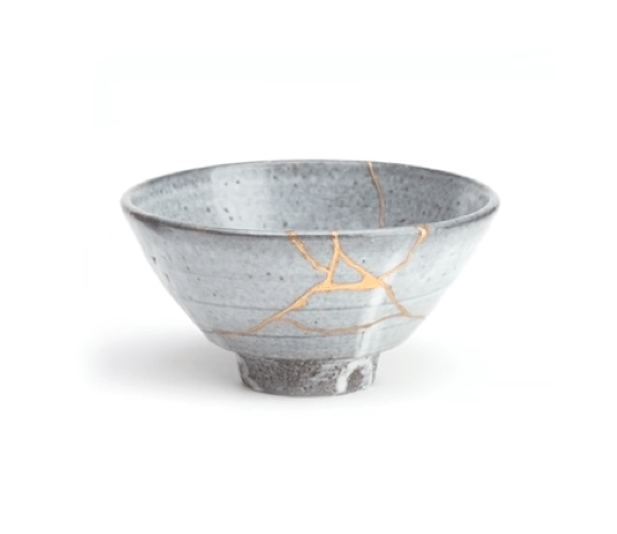
Kintsugi is the name for a broken pot or vase that has been repaired with gold, or gold-dusted lacquer, instead of a simple glue that might disguise the cracks or fractures. When the precious metal is applied to the imperfections, the vessel transforms from something broken into a work of art.
I was instantly emotional at the imagery of a warm, healing gold liquid seeping into my mind and soul through all the cracks I had just moments before labeled “broken”. It poured through me and an ember of hope began to glow. My thinking mind stilled and became peaceful, as if there truly was a healing taking place.
The idea for this healing art form of kintsugi comes from the Japanese concept of “wabi-sabi”, or an acceptance that life is filled with transience and imperfection. In Buddhism, devotees are taught that existence will bear the marks of impermanence, suffering, and detachment. Suffering is just as much a part of life as joy. We need to remember that both are impermanent, thus bringing the third concept into play; detachment. Non-attachment is taught in most of the Eastern religions and is important in the practice of meditation. Nothing is perfect, and nothing is permanent. Meditation helps us learn to suspend judgement and live in the moment with what is instead of wishing for something different. That practice of living in the present is what makes life such a beautiful journey.
A common teaching in Kundalini meditation is that your present meditation practice can heal up to seven generations in your past, and strengthen seven generations into your future. This is the form of meditation I practice. It has been a winding journey of varying degrees of devotion, but I find myself constantly coming back. It has begun replacing the form of prayer I was taught as a child.
The practices of both prayer and meditation, or the results one hopes to achieve through one or the other, are not very different. In fact, I often consider them to be one and the same. They are both deep and profound expressions of hope. Hope for a better day, hope for healing, hope for a better reaction to a stressful situation, hope for a better job, hope for a better life.
It’s hope that keeps me coming back when I feel I’ve somehow failed myself or those around me. I love praying with my children and husband each night, and I love when my children come nestle next to me when I’m meditating. I love catching my daughter, cross-legged on the floor, doing her own version. There seems to be even more power when we do it together. When we unite together in prayer or meditation, we raise the spiritual level of this planet.
Studies have proven holy pilgrimage sites, such as Mecca, have a scientifically measurable level of energy that increases when groups of people unite in prayer. That true, measurable reality strengthens my belief in the tangible power of meditation, and the feeling it brings to my home. I have to conclude that the positive energy I create while meditating is what draws my children to me (as inconvenient as that may be in the wee hours of the morning).
My meditation definitely brought me a measurable increase in joy and healing today, and I’m so grateful for that long ago lesson on a Japanese art form I’d all but forgotten. I practice meditation and teach it to my children for that exact purpose. One day, down the road, when they are in a moment of grief or need, they will turn to their own practice and remember forgotten truths about their divinity and wholeness, and find their way forward.
 CeeMarieMargaret